A billion dollar idea?

It’s a lovely sunny day in the Spring of 2022.

You drive a full electric Ford with the new lithium silicon battery tech that holds about 1,000 miles of charge. Your car is very fast, almost silent, and it costs about $20 per month to charge at home… but you have solar so all your home charging is free.

You bought your Ford brand new, for $22,000.

Over breakfast you check your MoneyCharge app, it seems that there is a projected shortage of power in Clearwater Beach today! If you park there and give up 500 miles of charge you’ll get paid $16 and your parking for the day is free!

You drive over with some friends and the app directs you to an open upcharge / recharge parking spot near the Hilton. You grab your beach blanket and enjoy the day. When you get back to your car there is still 500 miles of charge left, which you can recharge back up to 1,000 miles when you get home.

$16 has already been electronically deposited in your account, bonus!

The MoneyCharge app communicates with the computer in your electric car, you can program it to give up X number of charge miles for X dollars based on your needed range. If your work commute is only 50 miles round trip you can plug your car in at work and sell 800 miles of range at a preset price.

The local electric grid would pull electricity at the lowest prices first, then step up the draw based on the power needs in that area.

A million electric cars each with a 1,000 mile range would become a massive mobile energy storage device for the power grid, your car could sit at work during the day getting charged by rooftop solar, then take that power home with you to power the local grid at night.

Power would flow back and forth, meeting the needs of the market on a minute by minute basis. There would be multiple sources to the grid; traditional gas and coal generation, nuclear, wind turbines, rooftop solar and battery storage from cars and homes.

A sophisticated energy management system using artificial intelligence could manage the ebb and flow if this energy in the most efficient way possible, saving money for the consumer as well as the electric utility.

This AI would track and anticipate patterns of usage over time, making energy management more predictable. Energy AI could also be tied into the weather forecasts, knowing how to anticipate cloudy weather and storms that could diminish the output on rooftop solar.

Of course, this will require the integration of the computer in your car, your home, the app on your phone and the computer powering the grid.

I have the SolarEdge app on my phone (right now in 2017) that shows me the power output, in real time, of all the installed solar Tampa Bay Solar has in operation right now.

Having mobile storage that can communicate with the power grid allows for lower prices all around, if the electric company can get power from a hundred thousand cars they don’t need to fire up the coal gen or natural gas turbine as often.

During high peak usage days (like when the Northeast saw 100 degree temps) this system would draw from rooftop solar and energy stored in electric cars, in addition to coal, natural gas and nuclear.

On hot summer days rooftop solar still produces until 5 or 6 o’clock in the evening, at least here in Florida. I can show you on my SolarEdge app!

There will also be energy storage in your home, probably a larger version of the battery in your car. The MoneyCharge app would track all the power stored in your vehicles as well as your home.

Depending on the size of your home battery you might have an entire week (or month) worth of charge. Even in a long term utility blackout your system would recharge with solar everyday, and if enough homes had electric cars and rooftop solar no one would lose power.

Even if a home did NOT have solar they might be willing to pay a premium to keep the power on, especially if it was only for 2 or 3 days.

Some communities in Florida lost power for a week after various hurricanes blew over and knocked down power lines. Hurricane Wilma did this back in 2005:

The old-timey power grid can get really messed up by a CAT 4 hurricane.  

By 2022 volunteers should be able to drive into storm damaged areas and donate 800 miles of charge while they help clean up the area. Organizations like FEMA and the Red Cross might also deploy huge batteries pulled by tractor trailers, along with rapidly deploying high efficiency solar arrays.

Other than the 1,000 mile battery all the technology is possible NOW to make this idea happen, most of this system involves software integration between electric cars, charging stations and the wider power grid.

We need more car chargers, more electric cars, and more rooftop solar… but that is only a matter of time.

Elon Musk probably has a team working on this idea right now.

Ben Alexander

June . 2017

Swimming to live 100 years.

I’ve been getting up with the sun and hitting thirty laps every morning in this pool:

At first I was going to just post a picture of a random pool off Google, but then I typed in the name of my subdivision here in Wesley Chapel and found this picture! Kudos to the real estate agent who posted this pic on the interwebs.

I started to use our community pool on a regular basis when I moved to this subdivision 14 years ago.

I have to share the pool with all the folks in the community, but if I show up at 7AM I get to have it all to my lonesome. The pool is NOT heated, so I’m the sole user from about November to March. Even on a sunny February afternoon no one wants to swim in a 55 degree pool. Except me.

Cold water swimming is a rush, that’s if you can get past the first initial shock.

In my 4 decades I’ve tried many types of exercise, from running and lifting weights to boxing. Running was great, except for the fact that my feet and knees hurt nonstop. Boxing started to mess up my hands and shoulders.

Even doing the elliptical started to mess with my hip, what the heck?

Swimming has never made my joints feel creaky. I mix it up with breast stroke, freestyle and side stroke. Constant movement, followed by 10 minutes of stretching while in the pool. I wear a mid-thigh speedo, earplugs and swim googles.

My Mom is 68 years old and she swims several times each week.

The key is to find some type of sustainable exercise that won’t debilitate you as you age.

If you have extra weight on your frame it won’t matter in the pool. I don’t notice my extra weight in the pool like I would if I had to run a fast mile! If anything I’m a stronger swimmer today than when I was an 18 year old lifeguard and track athlete.

The weight loss plan for swimmers is very simple: eat smaller portions, swim more laps.

Ben Alexander

June . 2017

A 5-6 year ROI on Commercial solar!

The picture above is the headquarters for Suncoast Federal Credit Union’s headquarters in Tampa. This was a commercial solar install completed by Tampa Bay Solar last year.

Systems like this typically pay for themselves within 5 to 6 years, and after the payback these panels will generate electricity for several decades!

Right now there is a 30% tax credit on any solar install, along with accelerated depreciation on the remaining balance.

This means that the panels on your commercial building pay you back THREE ways:

  1. Production of electricity, maybe even your entire bill.
  2. An immediate 30% tax credit THIS year.
  3. Depreciation over the next 5 years.

High quality solar panels only lose half of 1% of power production per year, this means that the panels we install today will still be at 75% production in the year 2067!

The smart folks at Suncoast FCU will pay OFF their panels around the year 2023, yet the system will generate all the electricity they need for many, many years after.

Every business in Florida uses electricity, to some degree. Any smart business owner is looking to reduce their fixed facility costs, and the long term costs of solar are MORE predictable than the future rates from the electric company.

If you own or manage a facility with a huge electric bill you know with 100% certainty that your electric bill will continue every month as long as you run that property.

Even if you install high efficiency HVAC equipment and LED lighting you will still use a specific number of kilowatt hours each month.

Solar builds more predictability into your P&L spreadsheet and insulates your business from inflation and price hikes from the local utility.

You will still be tied to the local power grid, your business will still pay a (small) monthly utility bill, but most of the power generation will come from your roof.    

If you would like to get some hard numbers on solar for YOUR business please reach out to me at 813. 391. 3895

Have a Great Day!

Ben Alexander

TampaBaySolar.com

May . 2017

The 4-banger is dead.

My prediction: by 2022 there will be an inexpensive electric car on the market that will travel 500 miles per charge. When this happens the traditional 4 cylinder commuter car will slowly go extinct.

The 2017 Chevy Bolt pictured above is one of the first fully electric cars in the $30,000 price range with over 230 miles in full electric range. There have been other electric cars on the market like the Nissan Leaf, but the 100 mile range on the Leaf is too limited for buyers who have a longer daily commute.

I drive a 2013 Chevy Volt, which has 38 miles of electric range before a gas generator kicks in to power the drive motor. I’m still getting over 100 miles per gallon on days when I drive less than 45 miles. My Volt is FOUR TIMES more efficient than the Toyota Avalon it replaced.

In electric mode my Volt is smoother, quieter and MUCH faster than any 4 cylinder car I’ve ever driven. Driving an electric car is similar to driving a very refined Lexus V-6, if Lexus was able to totally eliminate engine noise.

Occasionally I have to drive my daughter’s 4 cylinder Honda Accord, the Accord feels like a dinosaur of old technology compared to my Volt.

An electric car with a 500 mile range, priced like a Civic or a Corolla, will dominate the commuter car market. In 2 car households they might keep the SUV or the minivan as the 2nd vehicle, but the spouse with the longer commute will love the improved driving dynamic and low fuel costs of the 2022 electric car.

It costs about $30 per month to charge your electric car at home, even cheaper if that homeowner installs a small solar array on the roof.

Check this out:

Gas stations will slowly go out of business, so will national chains like Jiffy Lube. No need for an oil change in a car with an electric motor. Electric cars require much less maintenance, and last far longer. Gas powered cars are crammed with complex parts; radiators, exhaust systems, oil pumps and alternators fail on a regular basis. Electric cars don’t need any of these components. There are no drive belts that need to be replaced… and less brake wear because regen brakes slow the car more than the brake pads.

Even if gasoline stays below $3 per gallon it can’t compete with cheap electric rates, which are the equivalent of about 40 CENTS per gallon. Once we have electric cars that can go 400 or 500 miles per charge it will seem silly to buy a noisy and expensive gas powered vehicle.

If the electric company decides to jack up electric rates the consumer can install solar to offset the increase.

Your roof will replace your gas station.

Ben Alexander

May . 2017

Flooded Beach homes.

Here is a chart on the rise of sea levels since 1993:

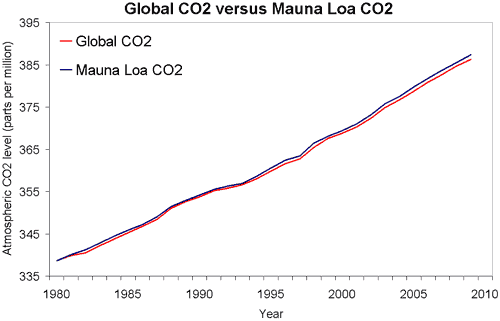
Here is a chart detailing the rise of atmospheric carbon dioxide since 1980:

I’ve been selling residential solar in zip code 33703, a community just east of St. Petersburg with many expensive homes that sit along the Tampa Bay waterfront.

Some of the well-heeled folks who live in that area are retired, others are still working as corporate executives, lawyers and successful business owners. Many of the long term residents of 33703 have observed more flooding in their zip code over the last 5 years, especially when Tampa Bay is at high tide.

There are some voters on the right who don’t believe that global warming is the result of rising CO2 levels, they’ll tell you that this is the “natural cycle of things”. In others words, correlation of the 2 charts above is not causation…

There are many factors that will reduce CO2 emissions over the next 30 years; widespread solar, more hybrid and plug in electrical vehicles, more offshore wind turbines, etc.

I hope that the wealthy executives who own beach homes will start to pour some investment into technologies that will reduce the amount of carbon dioxide in the atmosphere. Or they all might move to the mountains as the entire Floridian peninsula becomes a huge underwater coral reef.

One simple solution is to desalinate water and grow forests in the desert areas adjacent to our oceans. Every time you grow a tree you naturally sequester a huge amount of carbon dioxide.

You can desalinate water using solar power, and there are many places where the desert meets the ocean (Mexico, Africa, etc.) With the right technology and capital investment you can make the desert bloom, look what they did in Israel:

http://www.oired.vt.edu/compass/desert-bloom-incredible-story-agriculture-israel/

More plants = more carbon dioxide captured and used to grow food and create economic opportunity.

Just as the horse and buggy has become an icon of the past so will diesel trucks spewing exhaust and electric generation plants burning coal. By 2022 we’ll see inexpensive electric cars on the market that get 500 miles per charge… and soon after that gas powered cars will go away as well.

Ben Alexander

May . 2017

1,000 solar clients.

In the next few years one of my goals is to help 1,000 clients go solar.

Most of these will be residential systems that help middle class homeowners slash their electric bill from $200 or $300 down to $10 or $15. When they pay off their panels their electric bill will stay low for decades, the panels we install today will produce energy for (at least) the next 60 or 70 years. SolarWorld panels lose half a percent per year in output. Twenty years from now our panels are still at 90%. That’s pretty good.

In 50 years our panels will still be at 75% power output. I’ll be 93 years old.    

Some of these 1,000 clients will be business owners who own a laundromat, a restaurant or a warehouse. If they have enough room on their roof we can take a $1,000 electric bill down to $10, the business owner will get a 30% tax credit plus accelerated depreciation on the cost of the system. Less energy costs forever, lower taxes for the next five years.

1,000 clients with solar means less coal and natural gas being burnt, less nuclear fuel that needs to be disposed of, less harmful pollution overall.

1,000 installs means more work for the Army / Navy / Marine veterans who work for Tampa Bay Solar, more work for the workers at the SolarWorld panel factory in Oregon, more work for the good people who make the inverters, optimizers, roof mounts and rail systems that we use in every install.

More solid American jobs, right here in our backyard. There are already over 250,000 people working in Green Tech here in the United States, 1,000 completed solar installs accelerates that job growth.  

1,000 clients gets us that much closer to a smarter electric grid that ties in electric cars, energy storage, utility electricity and rooftop solar. A smarter grid will manage multiple sources of energy so efficiently that blackouts and brownouts will be unheard of, a thing of the past.

Many of my 1,000 clients will be retired folks on a fixed income, for these folks solar on the roof NOW is a hedge against future inflation; they are buying panels at today’s prices because no one can predict how much Duke Energy or TECO will hike rates over the next decade!

For my younger clients with small children we know that the panels will be paid off before their kids are done elementary school, for these families they will save $2,000 to $3,000 per year in electricity costs, that money can be used for the kids’ college fund, or to pay off debt.

As more people start to buy plug-in electric cars they will be glad that they put solar on their homes and businesses. Instead of using Exxon Mobil to fuel up their cars they can now charge up at home or work, using the sun as a fuel source instead of gasoline.

In return for selling 1,000 solar installs I’ll make a decent income that will help me pay off my home, put both of my daughters through college, and help me build up some savings for retirement. I think that’s a fair trade for 100,000 doors knocked, 5,000 appointments kept and countless phone calls in between!

Ben Alexander

TampaBaySolar.com

May . 2017

$183K paid off.

I’ve been focused on paying off debt since 2014.

I’m not debt free YET, but so far we’ve paid off over $183,000 in mortage debt, car loans, credit cards and business loans. These pay offs came from my wife’s income as a realtor, in addition to my profits from Balloon Distractions, Life Leadership and my more recent sales work with Tampa Bay Solar.

You don’t need to go into debt to grow a business!

The Financial Fitness program sold by Life Leadership set me on this path, and I’m grateful for all the good folks in that community who encouraged me to “keep going”.

Big thanks especially to Randy Crain and Steve Duba for sharing the Life business with me back in early 2014. I had no idea I needed this program, but I’m glad they took the time to share it with me.


Stuff paid for on credit will not make you happy, and in the long run debt causes more stress, especially if you struggle to cover a bunch of payments each month. As I get older I’m more interested in having peace in my life. When college is paid for (for my daughters) and my home is paid off I’ll be a happy guy.

I run into folks who are 75 who still have a mortgage on their home. That’s insane. With some focus and discipline you can pay off your home in your 40’s, maybe even your 30’s with careful planning.

If you look at your mortgage balance and feel like you can’t pay it off (at your current income) you might want to consider that you’re living in too much home!

My goal (when I’m debt free) is to live on less than ONE THIRD of what I earn after taxes. This will give me the flexibility to live on my terms, without feeling the need to work like a dog just to meet my obligations.

If you want to learn more about the Financial Fitness program feel free to comment on this blog or reach out to me otherwise.

Thanks!

Ben Alexander

May . 2017

Why I sell solar.

I’ve always been interested in green technology, going all the way back to 2001 when I worked for Toyota and sold the first generation Prius. I bought my first hybrid car in 2011, today my wife drives a Toyota Prius and I drive a Chevy Volt, our first plug in hybrid vehicle.

I’ve been an avid student of all things green for over a decade, from photovoltaics to wind turbines to electric vehicles. Even as I grew other business ventures green tech has always occupied some real estate in my brain.

Earlier this year I met Steve Rutherford and asked him to teach me the residential and commercial solar business. I was itching to get back into green tech, provided that I had the flexibility to work on my own schedule.

Steve is a graduate of the US Naval Academy in Annapolis, a retired Navy SEAL and the owner of Tampa Bay Solar, here is a local news article about him from the Tribune:

http://www.tbo.com/list/military-news/new-venture-helps-tampa-veteran-see-the-light-20141110/

I liked how TBS was veteran owned, and how Steve’s solar installers came out of the military and were able to learn a useful skill as a civilian. I could really get behind that, and as I learned more about Steve and his company I was impressed with the high level of excellence he brought to everything he did.

I don’t want to sell anything that is mediocre, dishonest or subpar. I want to be proud of what I sell, who I represent, and the company that I’m selling for. I also wanted to work with people of integrity, excellence and intelligence.

I’m still learning from Steve, he’s showed me how he works with clients, answers their questions, and gets them started with solar. There is a technical learning curve to green tech that anyone in this business needs to master, as we’ve sold new installations I’ve been visiting with our install crew, getting up on the roof and seeing how everything works firsthand.

We are adding solar to several new homes each week, with many businesses coming online as well. Each roof with solar means less fossil fuels burned to generate electricity.

TBS uses LG panels, which have a rock solid 30 year warranty.

The panels we install today have a performance guarantee that runs out to the year 2042! I’ll be really old and our panels will still be generating electrons every time the sun shines…

That’s pretty cool.  

I don’t have to sell a single solar panel to pay my bills, I have multiple streams of income that I’ve developed since 2003. Anything I earn from TBS goes towards paying off DEBT, my goal is to own my 4 bedroom home free and clear before I turn 45 years old.

I don’t have to pressure anyone to go solar because I don’t need to. I can present the facts, answer their questions, and if the client sees the logic of our solar proposal they can move forward, or not.

We live in a free country, if you want to pay the electric company $100,000 over the next 30 years that’s your choice. OR you can install solar and pay about 10% of that cost and OWN your power generation, forever. YOUR call.

Ben Alexander

April . 2017

3 people, 3100 miles, $212 at the pump.

My daughter Grace got a full scholarship to both Vassar and Carnegie Mellon, so we decided to take a spontaneous road trip to go visit both campuses. We started on Good Friday and drove through the night to Pittsburgh. We took my Volt, and most of the trip was on gas since we had few places to charge it up.

I paid for the gas with my debit card in order to tabulate the total off my online bank statement. The Volt only has a 9 gallon tank, but that got us about 270 miles per tank. Everyone needs to get out of the car every 270 miles, so it works out well. My average top off was normally $15 to $20.

My wife and I traded off on the driving, Grace took a nap in the backseat. By the time we reached Pittsburgh we were tired, but we spent the morning walking around the campus, took a nap that afternoon and walked around Pittsburgh a little more. There was a FREE high voltage charger at Carnegie Mellon, along with preferential parking for electrical vehicles!

Easter morning we woke up and drove 3 hours north into New York state to see Niagara Falls, my wife had always wanted to visit, and we were already just a few hours away.

Monday morning was a 5 hour haul across NY state to Poughkeepsie, where we toured Vassar’s campus. The next day we headed south again, visited family in New Jersey, and drove through the night (again) to get back to Tampa by Wednesday afternoon.

Three people, 3100 miles, $212 spent on gasoline. We also had extra costs from meals and snacks, but we would have eaten anyway so I don’t count that. If we had flown up we would have needed to rent a car, at least another $150.

It looks like Grace has decided to go to Carnegie Mellon, so it looks like I’ll be driving up to Pittsburgh again, probably in August.

Ben Alexander

April . 2017

The Electric Company will survive.

The picture above is a solar generation facility in the United Arab Emirates that is owned and operated by the local electric company that services Abu Dhabi. It was cheaper to build this facility than to construct a generation plant that would burn fossil fuels.

Solar facilities require less workers, with zero ongoing fuel costs. The typical coal generation plant costs over $2 billion dollars to build, a comparable solar facility is a far smaller capital investment.

As I’m out and about selling solar and talking about green tech with homeowners and business people I sometimes get this question: “What will happen to the electric utility when everyone gets solar?”

Some homes will never get solar. Either the roof faces the wrong direction, the home is surrounded by shade trees, or the homeowner refuses to invest in the equipment.

Many homes are owned by large real estate investment funds and will always be rented out to tenants, so the landlord has zero incentive to install solar since the tenant is responsible for the electric bill.

Even if the electric company jacks up rates there will still be stubborn luddites who reject solar, for the same reason that people will still drive gas guzzling cars and SUVs even after the local Exxon station starts charging $10 per gallon.

For these reasons the electric company will survive, but they will have to adjust and adapt their business model as more rooftop solar comes online. As the utility implements more solar their long term costs should go down, making power from the grid less expensive.

Ben Alexander

April . 2017