Less Debt, Less Stress.

SHarks with hats

When I pitched Balloon Distractions on Shark Tank back in 2014 I had a ton of debt and my life was a constant struggle to pay the bills every month. I had overextended myself with business loans, while at the same time my income went DOWN as Balloon Distractions peaked, then got smaller while the fixed costs remained the same!

My finances were a mess, my life was a mess. These things tend to go together.

I bought a bunch of used paperbacks about living debt free, reduced all my expenses and started to hack away at my smallest debts, paying them off one by one. Some of the personal finance authors I liked were Dave Ramsey, Orrin Woodward and Chris Brady. You can buy their books used and cheap on Amazon.

In 2017 I got into the solar business with Tampa Bay Solar, and my income increased. That same year I went through a divorce, so there were expenses there, but I kept living BELOW my means and paying debt down. I put $30,000 into my daughters’ college fund and now they’re both on track to finish college debt free, and I’m damn proud of that!

I live in modest home that I can easily afford, the solar on my roof is paid off, and my solar powers my Chevy Volt, so I spend very little $$ on gasoline.

My monthly electric bill is only a $32 connection fee with the local electric company!

Last month I paid $7,700 for a totally new HVAC for my house, cash.

I still have a modest mortgage payment, and I recently had to buy another car (used 2017 Volt for under $20,000) but I’m on track to live on 33% of my income this year.

I just got the car a month ago, I’ll pay it off by June. Then I’m hacking away at that pesky mortgage.

My life is really simple now, I can sit down and pay all my bills in a few minutes, with extra left over in the checking account.  I have NO credit cards now, only a debit card with a finite balance.

If you struggle with personal finances buy some used paperbacks on Amazon from Dave Ramsey, Orrin Woodward or Chris Brady.  I read books by all three authors and I’m at PEACE now when it comes to my personal finances.

These three authors have changed my thinking about money, and I’m eternally grateful to them for doing so.

Ben Alexander

TampaBaySolar.com

January 2020


4AM… and a new decade.

cliare

Me and Claire… in the beginning of the 2000’s. I had more hair back then…..

I got up at 4AM (this fine January 1rst) to drive my daughters to Tampa International for a flight to Puerto Rico. Claire has a friend getting married there and was nice enough to take her little sister as her “plus one”.  Claire turns 22 in a few days, Grace just hit the 20 mark. My Christmas gift to my girls was the round trip airfare.

On the drive home I was thinking about how things change as the decades have turned over in MY life and in the world in general.

The beginning of the 90’s found me in tenth grade at Clearview Highschool.

In 1990 the internet was only used by certain scientists and cell phones were only used by wealthy people. Most people had landline phones with rotary dials hanging on their kitchen wall. Microwave ovens were newfangled technology in 1990…. Long distance calls cost over $1 per MINUTE or even higher.

By the first day of 2000 I was a young married guy with a 2 year old daughter (pictured above) and a 3 DAY old newborn! I had only had a cell phone for a little while, and still used paper maps to get to my appointments as an insurance rep for Mutual of Omaha. I lived in a little 2 bedroom apartment with my family…. the internet was still at snail slow dial-up speeds. There was no Facebook or Instagram. In 2000 there were ZERO plug-in electric cars for sale anywhere, and the Prius hybrid technology was brand new.

By 2010 my girls were in elementary school, I was still married, and the owner of Balloon Distractions, a company that had expanded across the country with several hundred performers in multiple time zones. The ABC show Shark Tank had started to become popular, but I could not have predicted that I’d get on the show just three years later!

In 2010 Facebook was only a few years old, the 2nd generation Apple iPhone was becoming common, and the internet had become faster and more widespread. Rooftop solar in the beginning of the 10’s was still pretty rare, and plug-in electric cars were a rarity. People still had landlines in their home in 2010….

So here we are on the first day of the roaring 2020’s. I’m not married (for now), with 2 daughters almost done college. My voice is on the local radio ads for Tampa Bay Solar, and I drove to the airport using kilowatts generated off my roof. There are billions of smartphones out there and the internet is 5G fast, even 3G fast in developing countries. YouTube has become a learning / entertainment resource for most humans, and services like Hulu and Netflix has replaced basic cable. Solar is on one out of 100 rooftops across the United States, and in higher concentrations in communities that my sales team has targeted. Weed and gay marriage have been legalized and more commonplace.

I feel very optimistic about the coming decade. By 2030 plug-in electric cars will outsell gas powered vehicles, last week Volkswagon announced that 50% of their product line will be full electric by 2025. Improved battery tech will surely increase the usable range of full electrics up to 400 or 500 miles, which will be a game changer for most drivers.

By 2030 prices on full electric cars will come down (just as prices went down for used hybrid cars like the Prius). The widespread use of electric cars will accelerate the adoption of rooftop solar. I’ve sold solar to homeowners specifically because they are planning to buy a plug-in electric vehicle.

In my personal life I’d like to still be ALIVE to see the turn of the next decade… but I’ll be 55 years old in 2030, and the actuarial tables predict that some men never reach that age. Of course, there were many people in my family who reached 90, so barring an accident or cancer you never know.

IF I’m still around in 10 years I’d like to spend that decade helping 100,000 homeowners go solar. I also have some solar related business ideas, but I’m also happy to just make a great living selling solar with my team at Tampa Bay Solar.

Of course, there are surprises in every decade. This is what makes life interesting.

Ben Alexander

January 1, 2020


Never needs batteries….

20191102_162428_resized

A few years ago I got a really cool (black on black) Citizen Eco-Drive watch and it was  stolen out of my car when I left the doors unlocked! Since then I’ve bought a few more of these watches, mostly because they charge off of ambient light and you never have to think about replacing the battery. A few hours of direct sunlight will keep these watches powered for a few months!

… a solar watch…

I bought the silver model pictured above at a pawn shop for $150. The grey model pictured below was $150 brand new, I like to wear it when I’m meeting with clients. It looks nice, but understated.

The type of watch a partner at a solar company might wear…

Eco-Drive watches are not overpriced BLING like Rolex or Breitling.

20191214_120554_resized

As a watch company Citizen has been around for over 100 years, and they have a gazillion Eco-Drive models to choose from, ranging from $100 on the more casual end up to $900 on the luxury side.

Some folks no longer wear wrist watches (because accurate time is on your phone) but I like the stylistic look of a nice watch, whether one is wearing a suit or just jeans and a polo shirt.

I’m 45 years old, and I’m at a point where I’m buying things that I want to keep for the long term, from well built furniture to quality motorcycles to solar panels. Citizen watches have an excellent track record for quality, so hopefully I can buy a model today and enjoy it for the next 40 years.

That same long term philosophy of quality and longevity applies to the relationships in my life as well, both personal and in business.

Going CHEAP will cost less in the short term, but it causes more headaches in the long term.

I know, this started as a blog post about watches, and morphed into something else. No one reads this blog anyway…

Ben Alexander

TampaBaySolar.com

December 2019

3 Simple Solutions to Global Warming.

tree

Plant another 10 billion trees.

The best way to remove CO2 from our atmosphere in the long term is to simply plant a tree. Trees turn CO2 into cellulose and continue to do so for at least a century, sometimes far longer. It costs a few dollars per tree and about 20 minutes of labor to plant a sapling.

Put solar on as many rooftops possible.

All the sunny rooftops within 2500 miles north and south of the equator are a good bet for solar. Every human in modern society will use electricity every day of their lives, and the traditional utility primarily burns fossil fuels to generate this electricity. Solar on every roof raises the inherent value of every home and business as well.

Electrify all ground transportation.

We still need fossil fuels for jet planes…. but not for trains, buses and automobiles. With solar on the roof and electric cars in every driveway it becomes far cheaper to fuel up our vehicles. I drive a plug-in electric car that charges off the solar on my roof. This system works, and my costs for the additional equipment is LESS in the long term.

These three steps are all practical and possible.

Ben Alexander

TampaBaySolar.com

December 2019


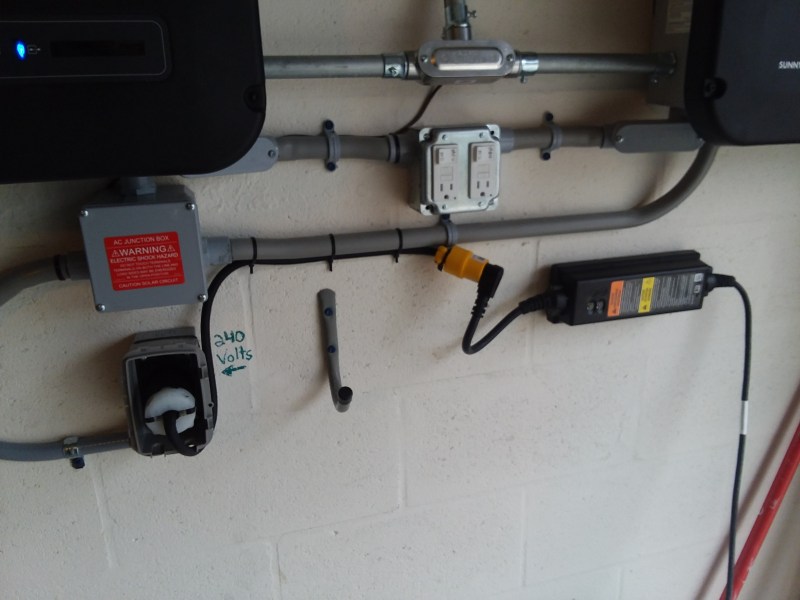
Hacking my Level 1 charger

20191213_083959_resized

Level 1 = 120 volts.

Level 2 = 240 volts.

The Chevy Volt comes with a Level 1 (120 volt) charger. This is the narrow black box pictured above. This can be plugged into any standard outlet, anywhere. The 2017 Volt with a 55 mile electric range takes 12 hours to charge using 120 volts. That’s kinda slow.

I have the option of burning gasoline if the Volt batteries are empty, but the electricity at my home comes from solar on my roof…. which is free, versus a gallon of gas which is NOT free, and never will be.

There are Level 2 chargers on the market that run off 240 volts, but they cost $400 to $600 bucks. They look cool, but WHAT IF there is a less expensive option?

There were a few videos online that showed Volt drivers running 240 volts on their Level 1 charger… so I had an electrician wire in a separate breaker and 240 volt outlet and with $10 in parts from Lowe’s I built a converter plug, crossed my fingers, and plugged it in….

It works folks. No problems, no overheating, no tripping of circuits.

WITHOUT buying a Level 2 charger I’m now charging my Volt in 4 hours vs. 12 hours!

My only costs were some parts from the electrical aisle at Lowe’s and $290 bucks to the electrician.

My previous 2013 Volt only got 30 miles per charge, so I spent about $20 per week on gas, with the longer range on my 2017 model combined with the fat charging I’ll use far less gasoline. I work for Tampa Bay Solar, and we are building a new headquarters in East Tampa with Level 2 chargers, so I’ll be able to charge my car at work for free when construction is complete in 2020.

Ben Alexander

TampaBaySolar.com

December 2019


HVAC and a 2017 Volt…

20191206_073141_resized

I live in a Florida home that was built in 1999. I’ve repaired parts of my HVAC over the last decade, but I knew the overall system was grossly inefficient because it was using 70 kilowatts per day in the summer months, to only cool 1900 square feet!

A typical home with a more efficient HVAC uses about 50 kilowatts per day.

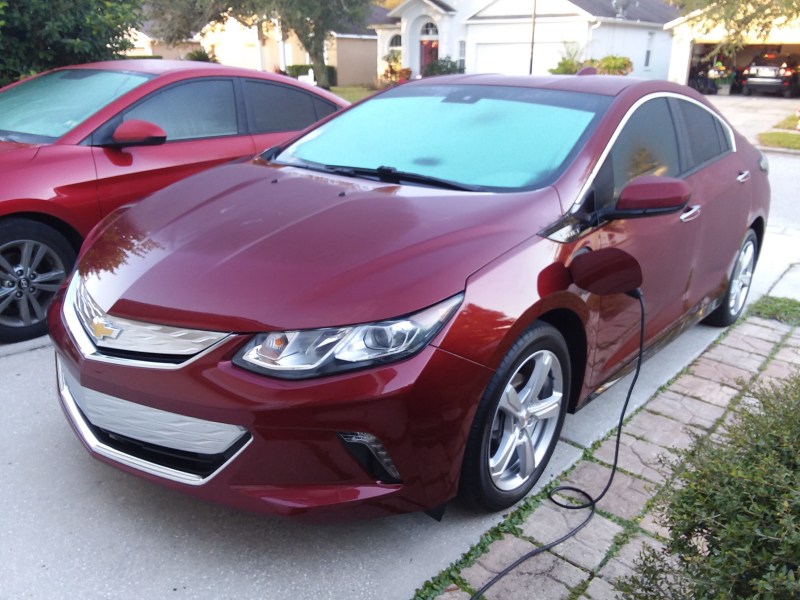
On the same day that I purchased my 2017 Volt (pictured above) my heat stopped working. When the repairman showed me the corroded and rusted out components in my HVAC I decided to pull the trigger on a brand new system. It was $7700 bucks total,  but knew that this was money that I’d have to spend eventually.

So what does my HVAC system have to do with my electric car?

The 2017 Volt has a 50 mile range, while my former 2013 Volt only had a 30 mile range. This means the new car will use more kilowatts, less gasoline. My old HVAC unit was wasting electricity, my new (16 SEER) HVAC unit will be more efficient, so the power saved with the new HVAC will power my car, and I’ll buy less gasoline.

Kinda interesting how my electricity and fossil fuels use are connected.

In reality all of our energy use is interconnected, if you’re a normal human being you use electricity and fossil fuels every single day. Most of the electricity from the power grid comes from burning fossil fuels; coal, oil and natural gas. So if you don’t have solar but you power your electric car off the traditional power grid you are still burning fossils!

20191211_125002_resized

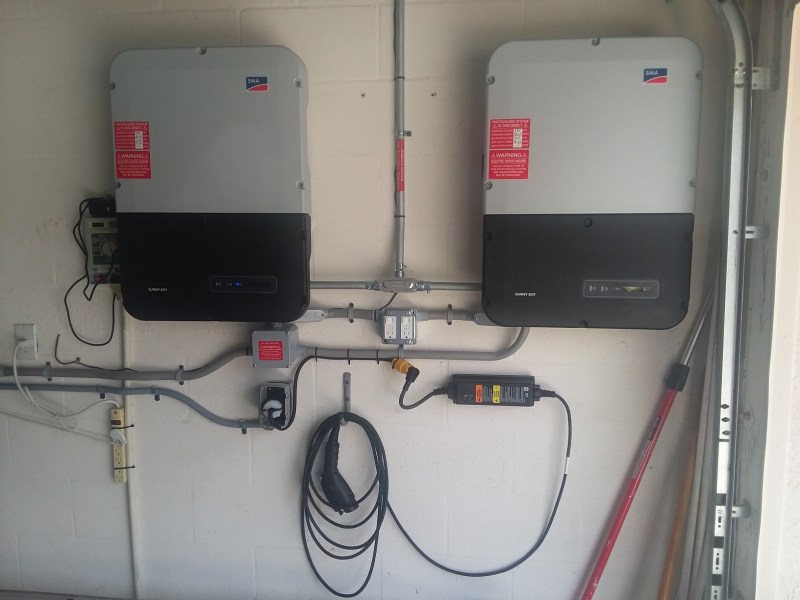
Pictured here are the solar inverters in my garage along with a Level 2 charger for my Chevy Volt. Note that I can plug the car charger into my secure power supply (outlet in the middle) if I lose grid power.

This means that I can charge my car even if there is NO gasoline and the grid goes dark.

Eventually all homes will have some power generation and at least one electric car. Some folks have already done this, the true believers who voted with their dollars. Then there are the folks driving huge pick up trucks in a big inefficient home, wasting a ton of money and fossil fuels because they just don’t give a rip about anything.

Not me, not if I can help it!

Ben Alexander

December 2019


Transition from 100% petro to 100% electric.

20191205_144931_resized

Pictured above is my 650 cc Kawasaki Vulcan S… most decidedly NOT an electric vehicle. There are some really cool electric bikes on the market but they cost $20,000. My little Kawasaki here was only four grand, out the door!

If you have a limited garage space but Jay Leno intentions you can start a motorcycle collection before you buy your McLaren…..

New fully electric cars are still expensive, until you factor in the used electric vehicle market. Case in point:

This past week I bought a 2017 Volt with 32,000 miles on it, for just under $20,000 including tax and tags (out the door, in other words). Back in 2017 I test drove the brand new Volts and loved ’em, but retail was $35,000, and even with a big tax credit it still would have cost over $32,000 out the door.

Do the math here, most modern cars will run to 200,000 miles without a major repair, so the 32,000 miles on my used Volt only represents 16% of the lifetime usage of the vehicle, yet $20,000 (cost of used Volt) represents 63% of the original price!

This is my quantitative economics brain at work here….

So, for 63% of the original price I get 84% of the usage of the vehicle. Those numbers make a ton of sense… and when we factor in the 50 mile electric range on the 2017 Volt, and the fact that my rooftop solar will power that need… this car might have the lowest cost of ownership (per mile) of any car I’ve ever owned.

If my Volt lasts until 2023 or 2024 I’ll be able to buy a used fully electric vehicle in great shape for around $20,000.

As for my motorcycles? I’ll keep the gas powered bikes, but if I get a deal on an electric bike I might need a bigger garage….

Ben Alexander

December 2019

Why I bought ANOTHER Volt.

20190202_070819

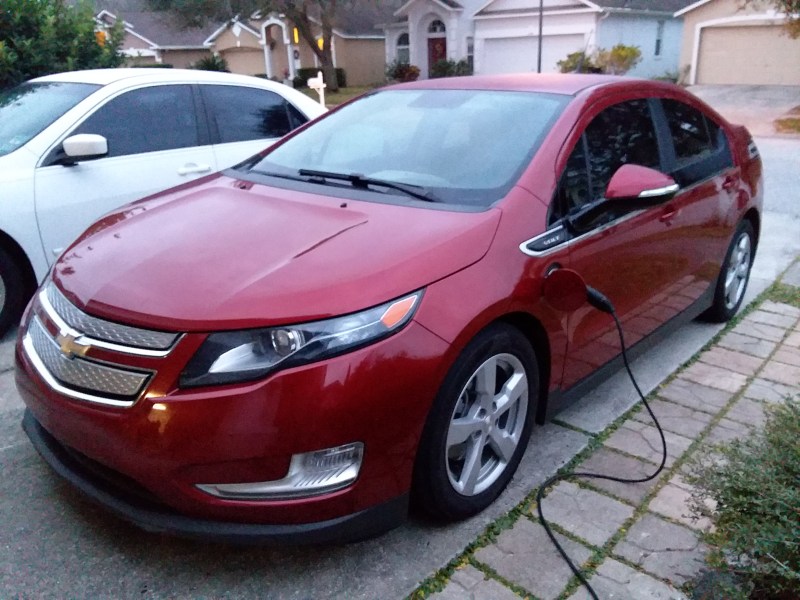
…. the 2013 Volt ….

On November 30th I was driving my 2013 Chevy Volt in Tampa and a random Dodge minivan turned into my lane and messed up the entire passenger side of my car. My Volt had 130,000 miles on it, and the Kelly Blue Book value was about $3,000, so when the other driver’s insurance offered me $7,500 for my old Volt I jumped on it.

Even if I sold my 2013 Volt privately I would never get $7,500 bucks for it, even before that accident, and the accident was not my fault, so why not get a newer car?

I did NOT expect to be car shopping 3 weeks before Christmas, but it seems the universe has a different plan altogether. For a hot minute I considered going back to a full gas powered car, simply because all the electric cars with a 300 mile range cost over $30,000, and I was trying to spend LESS than $20,000, out the door.

I test drove a 2015 Infiniti Q50 that was listing for just under $20K and I really liked it… but then I was talking with my girlfriend and she made a good point: “A luxury car is all about EGO, get another Volt and charge it off the solar on your house.”

I had test driven a 2nd generation Volt back in 2017 (my 2013 model was first gen) and I really liked it. So…. I found a few used 2017 Volts for sale across Tampa and went out to check them out. Brand new these cars go for over $30,000, but there were several used 2017 and 2018 models for sale in the low 20K range.

Yesterday I got a 2017 Volt at Dimmitt Chevy in Clearwater for just under $20,000 including all the tax and tag fees. It has a leather interior, 32,000 miles, and rides like a Lexus. My 2013 was very smooth, the 2017 is even smoother, quieter, faster and it holds a 50 mile full electric range vs. about 30 miles on the 2013 Volt.

The Volt goes into gas mode after the charge is exhausted, which means I can charge at home each night, but gas it on a longer road trip. BEST of both worlds, really.

Which brings us to the huge snorting elephant in the room…. why the hell did GM discontinue this model? The Volt is honestly a GREAT car, super reliable, rides nice, performs like a car with a V-6 engine…. AND I can use either gas or kilowatts.

If the Volt was made by Toyota it would outsell the Prius hands down. I owned a 2009 and 2011 Prius, both cars were slow and dopey compared to the Volt. Put any Prius driver in a Volt for just ONE DAY and they would not want to go back.

I think GM is being really shortsighted in getting rid of such a superlative model like the Volt. I’m glad they offer the (full electric) BOLT, but I feel like the dual fuel Volt still has a place in the car market.

Maybe I’m just different, I have a solar array on my roof that cost as much as a used car, 2 motorcycles in my garage, and a citrus tree in my backyard. I also went on Shark Tank for a frickin’ balloon company, so there’s that.

As for now?

I’m gonna drive this 2017 Volt another 150,000 miles or so and get a nice used electric car with a 400 mile range sometime in 2024…..

20191206_073141_resized… the 2017 Volt ….   same color was NOT intentional, but my other options were white.

-Ben Alexander

December 2019


The Future Of Energy?

Image result for cool looking electric cars

The state of Hawaii has more solar per roof than any other state. Since Hawaii is an island with no indigenous fossil fuel resources the state is forced to import fuel to power up the electric grid. Fuel costs drove up the price of electric, so Hawaiian homeowners adopted rooftop solar in a big way.

Solar energy production begins around 9AM, peaks at noon then diminishes until sunset. This poses a challenge to the engineers who manage the power grid, and in Hawaii Tesla has stepped forward with large battery banks that store solar during the day and redistribute the power at night.

What happens when 50 million homes all over the United States get rooftop solar in the next 20 years? Where will all that energy find storage? One solution might be to use electric cars as portable batteries during peak daytime solar production from 10AM to 3PM.

By 2030 there will be millions of full electric cars in use across the United States, and most of those vehicles will have a battery capable of storing 200 kilowatts. The average home in Florida uses about 50 kilowatts per day, and most drivers will use less than 25 kilowatts per day to power their commute, so it makes sense to use electric cars to store energy across the grid.

The existing electric companies could change their business model from the current “generate and delivery” dynamic to a more advanced “move energy from solar to cars to homes” model. As a consumer I would not mind paying a small monthly fee to the electric utility if I was able to move energy from my rooftop solar to my car and then back out to the wider energy marketplace.

Imagine an app on your phone that lets you sell the kilowatts stored in your car back to the grid based on demand at that moment in your area. Perhaps your park your car at work in a high energy-demand area, you could program the app to sell 20 kilowatts back to the grid, leaving enough charge in your car battery to get you home.

Of course, most homes and buildings will also have a large battery back-up capacity in house.

As solar goes up on homes and buildings around the globe the cost of electric will eventually drop to peanuts and the large electric companies will no longer be able to stay competitive using coal and natural gas plants that need to be staffed and fueled up.

The power grid will always be there, but the business model will shift over time.

The electric companies will probably have to outsource the technology to make this happen, so there is a billion dollar opportunity for the firm that develops this integrated technology and then sells it to the operators of the power grid.

-Ben Alexander

Director of Sales

TampaBaySolar.com

Going Debt Free with Greentech.

This is the solar hot water heater and photovoltaic panels on my roof:
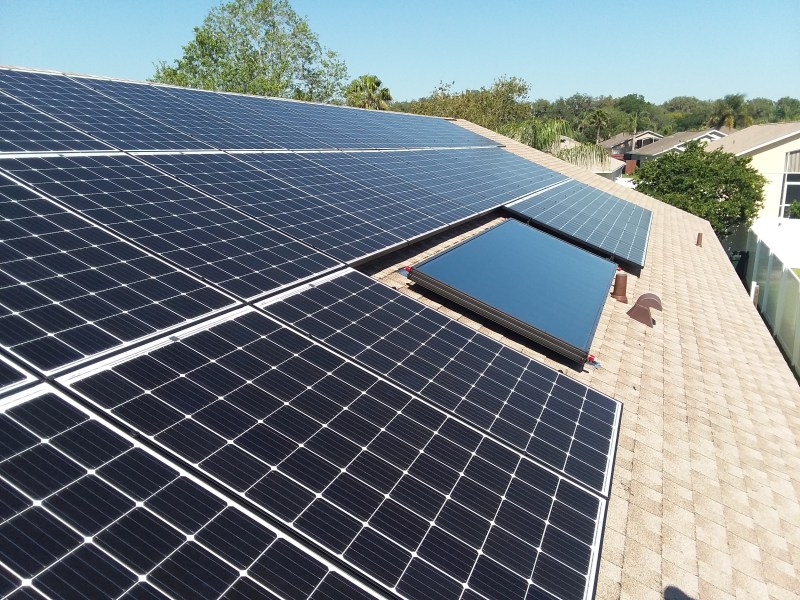
front of roof

For the last few years I’ve been teaching the “Go Debt Free” class at my church in Land O Lakes. Since 2014 I’ve personally paid off over $300,000 in debt, which is really my only qualification to teach the class!

My best student paid off $100K in debt within 2 years of taking my class.

The word “mortgage” actually comes from the French word “morte”, meaning death…. so your mortgage is really a “payment unto death”. It doesn’t have to be. You can pay off your mortgage in your 30’s or 40’s if you’re intentional about it.

I’m proud to say that my recurring monthly expenses are one third to one half my income, since I’m paid on commission which varies from month to month. My debt had been a combination of 2 mortgages, business loans, credit cards and car payments. The combined payments on $300,000 in debt was a crushing $4,200 per month. Ouch.

So what does green technology have to do with going debt free? Isn’t green technology far more expensive than standard technology?

Let’s look at cars for a minute.

When the Toyota Prius hit the market 18 years ago it cost $25,000, far more expensive than a $18,000 Toyota Camry LE model. The Prius got 48 miles per gallon, the 4 cylinder Camry got 28 miles per gallon. At $3 dollars per gallon over 100,000 miles the Prius owner will spend $6,200 on gasoline while the less efficient Camry driver will spend $10,700 at the pump.

Buying a new Prius does not make sense, but when you research the prices of a 3 year old Prius versus a 3 year old Camry (with similar mileage) the prices evened out. Most USED car buyers will own a car until it hits very high mileage (this is financially smart). As used cars you can get either model with 50,000 miles for about $16,000. Assume that you drive both cars for another 150,000 miles at $3 per gallon… the Camry driver will spend a whopping $16,000 at the pump, while the Prius driver will only part with $9,300 for gas.

What does green tech have to do with paying off debt? Take the $6,700 you will save by driving a Prius and pay down the mortgage on your home, or put that money in your child’s college fund, or just evaporate one of your credit card balances.

Most people don’t look at small recurring costs as huge long term costs. Who knew that a Camry uses $16,000 in gas over 150,000 miles? We just pay it and don’t think about it because we don’t think there is another option.

There is another cost in your life that most people are blind to because they feel powerless to get rid of it. If you own a home and pay $200 per month for electricity that’s $2,400 per year, well over $26,000 over the next decade when you factor in rate hikes and inflation.

A $150 per month electric bill is $19,000 over the next decade….

Most people think solar on your roof is far more than your electric costs. Not true since panel prices hit grid parity in 2016. A solar array that will generate $26,000 over the next decade (that’s a 10.5kW system) will cost you less than $18,000, even if you finance it. The array will evaporate a $200 per month bill and replace it with a $165 per month payment.

When the system is paid off in the next 6 years you will only pay a small monthly fee to the electric company. Currently the TECO fee is $17 per month, Duke energy’s fee is only $9.

The solar on my roof here in Wesley Chapel lowered my bill by $200 per month, $2,400 per year… my payment is only $135 per month because I put money down on the system.

Even after my solar pays for itself it will add value to my home. The panels have a 25 year warranty, so they should last decades. I’ll get my money back 3 or 4 times if I don’t move.

A few years ago I bought a 2013 Chevy Volt that runs on electricity only for the first 40 miles after a charge. This means that the solar on my roof is charging my car for FREE. The Volt only uses gasoline after the electric charge is exhausted, so there are many days when I use ZERO gasoline.

Consider your finances if you never spent another cent on gasoline… especially when gasoline goes over $4 per gallon. Some people spend $300 per month on gas alone. What if you used that $300 towards the principal on your mortgage?

By putting solar on my roof and driving a plug-in electric vehicle my costs for electricity and gas will be at least $15,000 LESS over the next decade. If I sell my home I’ll get a higher market value because of my array on the roof, especially as electric cars become more common.

You get what you focus on, you are less likely to take on silly debt when you are moving towards a debt free lifestyle. Read some Dave Ramsey books, get a notebook and start writing down your total debt numbers… as you get rid of debt your stress level will go down and you’ll find financial peace.

Ben Alexander / Sales Director for Tampa Bay Solar 813-391-3895